The Mystery and Miracle Plays were represented during the Easter period or during the festivals of Corpus Christi or Corpus Domini, but in some cities, such as Chester, they were also performed during the Whitsuntide, that was a religious festival to celebrate the arrival of the Holy Spirit on the disciples, and which is still celebrated long time after Easter.
The function of these plays was that of being a form of entertainment of a wide audience. The characters represented every person of the society: this is why, during the Middle Ages, the actors wore common clothes that would become more lavish later . The people who played these, the actors, formed a new social class, as for the first time in history they were grouped in crafts guilds, in which everyone had a specific role. Moreover, each guild was specialized in a specific kind of trade, therefore they could provide everything needed for the play, such as the costumes or the stage objects.
These plays usually took place either in mansions or on pegeants. The difference was just about the stability, as in the first case the scene remained fixed in a place, while in the second it was on a movable stage.
The mansions in the medieval theatre looked like houses or tents similar to those used to knights. These represented a specific location for the performances.
Instead, in the medieval theatre, the peagents were also used for other shows, such as, for example, dancing, fighting, or for entertaining an important person. The wagon on which the plays were represented was quite big, as it could have up to three floors and the number of carts wheels ranged from 2 to 6. On some carts there were even special effects props and the wagons were carried along the streets of a city in order to represent a drama several times during the same day.
Usually, the dramas represented on these peagents took the name of the city in which they were put on scene: an example of this was the so-called “Cycle of Chester”.
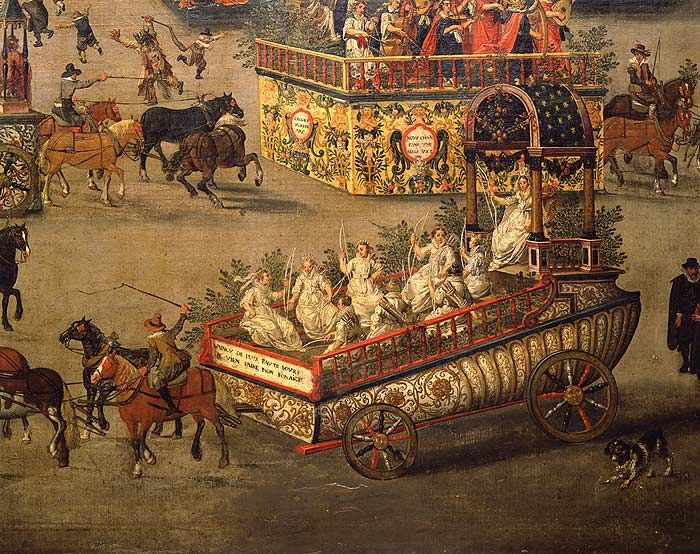
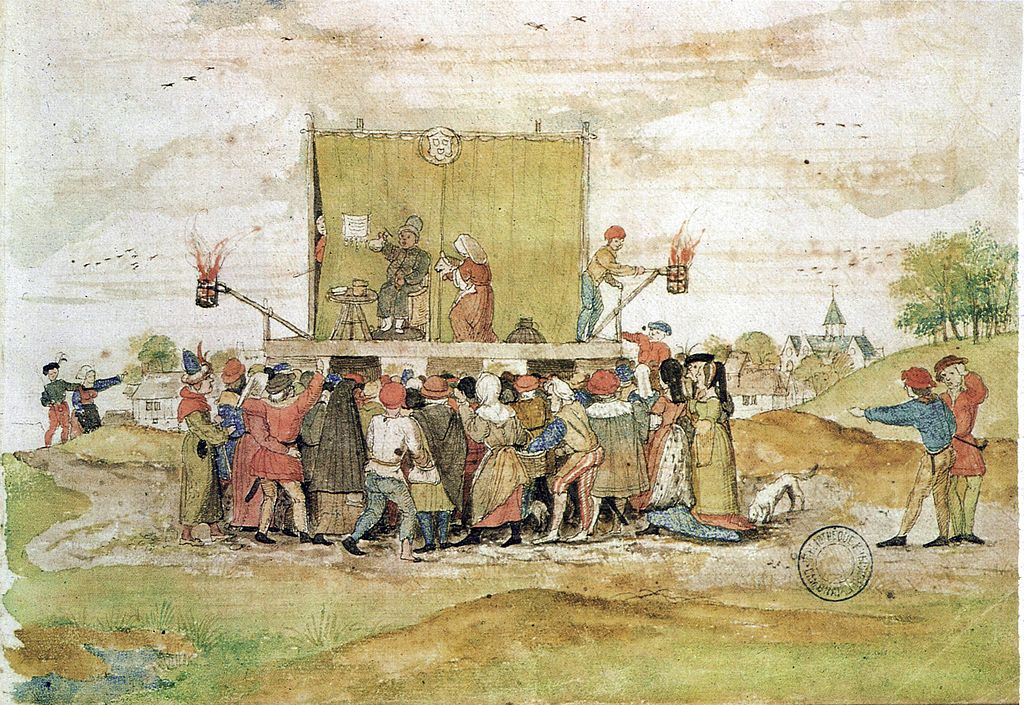
Another type of stage was the the booth stage, that was supported by these, with background with decorations on it. Around each one of these stages, there was a space reserved for the public to watch the show; sometimes it was also used by the actors, and some plays could be rappresented in different places and, therefore, the area of representation could influence the type of scenic space to be used.
After having noticed what are the different types of stage, we can observe that the way in which how pageants were used in the Middle Ages can still be found today; in fact these are used in carnival parades.
So, although this topic may seem very far from us, in various aspects of contemporany culture it is present. And it is incredible how the British culture of the Middle Ages influenced nowadays‘one. For this reason, it is right to recall this cultural phenomenon.